Western MA
The Berkshires
Western Massachusetts packs an improbable density of world-class culture, serious hiking, and exceptional food into one compact region. The Berkshires corridor — Lenox, Stockbridge, Great Barrington, Williamstown — sits 20–40 minutes from Worthington, and the closest natural attractions are practically on your doorstep.
Filter by season
11 places match your filters

MASS MoCA
One of the largest centers for contemporary visual and performing arts in the US, occupying a converted 16-acre factory complex. The permanent Sol LeWitt installation spans 27,000 square feet of wall drawings — a singular experience of scale and obsessive geometry. Jenny Holzer's text-based projections fill a vast chamber with Nobel laureate poetry. Rotating exhibitions change frequently. The campus itself, with its repurposed mill buildings and courtyards, is architecturally worth the visit.
Budget 3–4 hours minimum. The Sol LeWitt rooms are genuinely overwhelming — the scale only registers in person. Check the website for rotating exhibitions before going; some contemporary work rewards context. The campus café is a good lunch stop.

The Clark Art Institute
Founded in 1955 by Sterling and Francine Clark (heir to the Singer Sewing Machine fortune), the Clark holds one of the finest collections of French Impressionist and American art outside major metropolitan museums. Exceptional Renoir, Monet, and Degas; outstanding Winslow Homer, John Singer Sargent, and decorative arts. The campus is peaceful, the galleries are uncrowded, and masterworks are viewable at human scale. Free admission.
Combine with lunch at Mezze Bistro nearby and make a Williamstown day of it — the Clark, lunch, and a walk on the campus trails is an ideal half-day. Allow 2–3 hours for the collection.

Norman Rockwell Museum
The world's most comprehensive collection of Rockwell's work, but the real draw is his Studio — moved to the museum campus in 1986 and presented as it appeared in October 1960 when Rockwell was actively working. Brushes mid-stroke, props arranged, color references pinned to the walls. An intimate and surprising experience of the artist in the act of painting. Studio tours run May through October, are limited to 30 minutes, and require advance booking.
Book studio tours online ahead of your visit — they have limited daily capacity and fill quickly in summer. The studio tour is the highlight. Pair with lunch at the Red Lion Inn in downtown Stockbridge, five minutes away.

Mount Greylock
Massachusetts' highest peak at 3,491 feet, with summit views extending 90 miles on a clear day into five states. The Summit Road is open mid-May through late October; 70+ miles of trails access the mountain year-round. Bascom Lodge, built 1932–1938 of native schist and red spruce, sits at the summit and serves meals and overnight accommodation late May through mid-October. The Appalachian Trail crosses the summit. The Thunderbolt Ski Trail descends the east face — a historic racing trail from the 1930s.
Drive to the summit for the view and a meal at Bascom Lodge (reserve ahead for dinner). For hikers, the Bellows Pipe Trail is steep and direct; the Hopper Trail longer and more scenic. Early morning summits catch the sunrise over the valley fog.
Monument Mountain
A 503-acre reservation centered on 1,642-foot Peeskawso Peak, with dramatic pale quartzite geology and views to Mount Greylock and the Catskills. Three short loop trails, all under 3 miles. Monument Mountain is also a literary landmark: in 1850, Nathaniel Hawthorne and Herman Melville met here, climbed together, sheltered in a cave during a thunderstorm, and engaged in the conversation that shaped Melville's work on Moby-Dick. The encounter is celebrated as a turning point in American literature.
Hike the Hickey Trail up and Mohican Monument Trail down for the best 3-mile loop — steeper ascent, easier descent. The summit views are excellent. Go in the morning to beat afternoon crowds. The literary history makes it a reflective, genuinely special place.

Bash Bish Falls
Massachusetts' highest single-drop waterfall at 60 feet, with twin cascades splitting over boulders into a serene pool in a hemlock gorge. The approach from the New York side (Copake Falls) is a gentle 0.75-mile trail. The Massachusetts upper parking area is shorter but significantly steeper. Most dramatic in spring when snowmelt is at peak volume. The surrounding hemlock forest and mountain walls make it feel remote despite the short hike.
Visit in April or May for maximum water and spray. The pool at the base is tempting but cold year-round. Come on a weekday if possible — the small parking area fills by mid-morning on summer weekends. Allow 1.5 hours total.

Chesterfield Gorge
A 70-foot gorge carved by the East Branch of the Westfield River, managed by The Trustees of Reservations, about 10 minutes east of Worthington. The half-mile cliffside trail delivers dramatic views of the gorge, river, and hemlock forest for minimal effort. A 4-mile out-and-back extends the visit to about 1.5 hours. Dogs are welcome on-leash. Often less crowded than the major Berkshires attractions, and at its most dramatic during spring runoff.
This is your closest dramatic natural feature. The half-mile cliffside walk is disproportionately impressive for the effort — perfect for a morning constitutional or a family outing. Outstanding in fall foliage season.
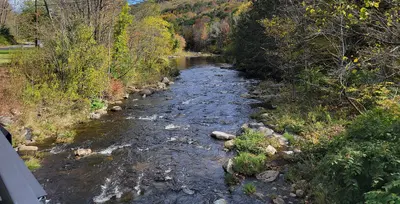
Photo: John Phelan, CC BY-SA 4.0, via Wikimedia Commons
Westfield River
A National Wild & Scenic River whose East, Middle, and West Branches wind through the hilltowns around Worthington — 78 protected miles in all. It's the only high-turbulence whitewater river in Massachusetts that isn't dam-controlled, with over 50 miles of whitewater in spring. The roughly 7-mile East Branch Trail follows the river from Chesterfield Gorge down to Knightville Dam on dirt road and single track, open to hikers, mountain bikers, and dogs. Nearby, the 1840s Keystone Arches railroad bridges on the West Branch and Glendale Falls in Middlefield make excellent short outings.
Fly anglers should head for the roughly 7-mile catch-and-release, artificial-lures-only stretch of the East Branch from the Chesterfield Gorge lot down to Knightville — wild and stocked trout. Spring runoff is powerful and cold; stick to public access points, and note that swimming and climbing are prohibited at the gorge.
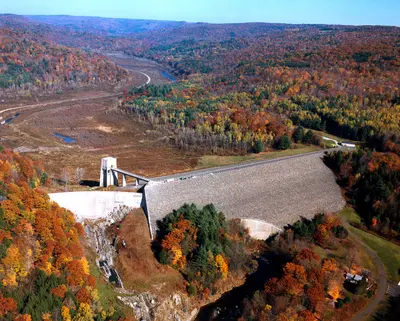
Photo: U.S. Army Corps of Engineers (public domain)
Knightville Dam
Built by the U.S. Army Corps of Engineers between 1939 and 1941 after the devastating flood of 1936, Knightville is the oldest dam in the Corps' New England District — a 1,200-foot-long, 150-foot-high rockfill dam on the East Branch of the Westfield River. It's a "dry" flood-control reservoir, so the river usually runs free through the basin, surrounded by about 2,400 acres of public land for picnicking, hiking, fishing, and horseback riding, with cross-country skiing and snowmobiling in winter. The southern end of the East Branch Trail from Chesterfield Gorge finishes here.
Go in early October — the view up the valley from the top of the dam in peak foliage is one of the best in the hilltowns. The river is stocked with trout in spring and fall. In spring, high water can flood the basin and close parts of the trail.
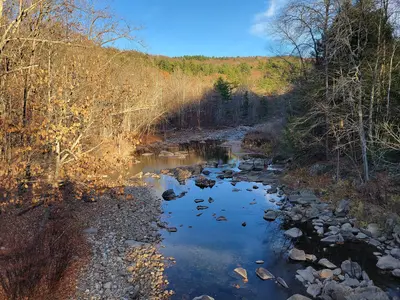
Photo: John Phelan, CC BY 4.0, via Wikimedia Commons
Fox Den Wildlife Management Area
Nearly 6,000 acres of protected forest managed by MassWildlife across Worthington, Middlefield, and Chester, rising from about 700 feet along the Middle Branch of the Westfield River to 2,000 feet on Pelton Hill. Northern hardwoods, hemlock ravines, and spruce plantations shelter deer, turkey, grouse, black bear, bobcat, and the occasional moose. Like all wildlife management areas, it's intentionally wild — no maintained trails or facilities, just old roads and quiet woods for hiking, birding, and fishing.
Park at the roadside pull-offs on Buffington Hill Road or West Street in Worthington, or Chipman Road in Middlefield. This is active hunting land, so wear blaze orange from fall through December and check MassWildlife's hunting season dates before you go.
Hiram H. Fox Wildlife Management Area
Around 3,800 acres of rolling hills, ledges, beaver wetlands, and vernal pools spread across Worthington, Chesterfield, Chester, and Huntington, managed by MassWildlife. Mass Audubon lists it as an Important Bird Area; a forest bird study running since 1987 has recorded more than 100 species here, with red-eyed vireos, ovenbirds, and black-throated green warblers among the common breeders. The trails heading south from Chesterfield Gorge toward Knightville pass through the area.
Late May and June mornings are prime for birding — bring binoculars and listen for warblers. There are no maintained trails or facilities; park roadside on Goss Hill Road or Route 112 in Worthington. Wear blaze orange during fall hunting seasons.
Places to stay